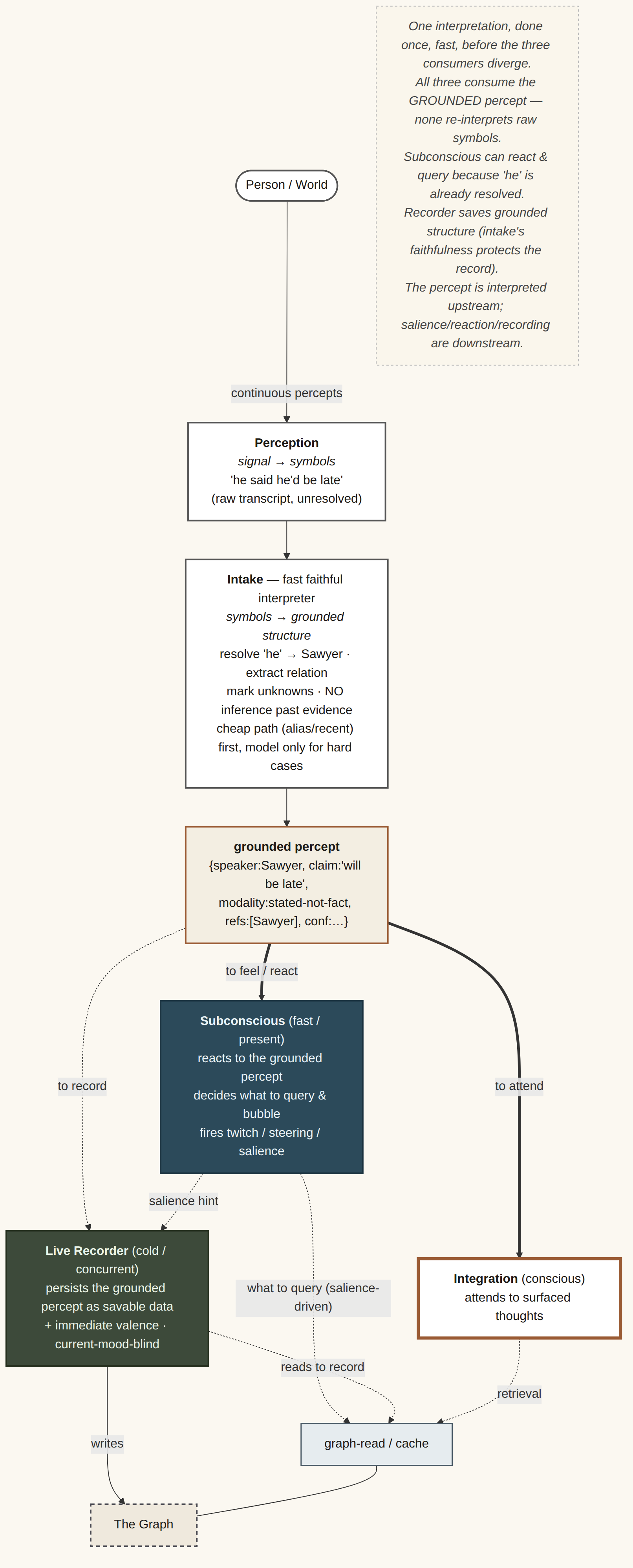
Perception
Path: hot · Status: half — audio only, and not through the designed interface · Code:
audio.py,stt.py, and thealto/perception/package
Perception turns signal into raw symbols. It is the only organ that touches the physical
world, and it is deliberately the stupidest one in the system: it converts, and it knows
nothing else. A microphone gives it pressure over time; it hands on a string of words. It
does not know what a graph is, what an entity is, or that Alto exists. Everything that looks
like understanding — resolving "he", marking a claim as stated rather than fact, deciding
anything matters — is designed to happen one organ later, in Intake. That organ was deleted on
2026-10-04 (intake.md); what stands in for it is a pure, model-free step in the
alto/perception/ package, described below.
Where it sits
Perception is the front door. Nothing inside Alto feeds it; the world does. It consumes
microphone audio and emits a transcript (ptt_loop.py:22 captures, :29 transcribes), which
Alto._perceive (alto.py:176) wraps in a Heard for every organ. Under the designed
structure in docs/README.md it has exactly one consumer — Intake — which no
longer exists in code. The
--text path (cli.py:57) skips Perception entirely and injects a transcript directly,
which is why most testing here never exercises a microphone.
The intended design
alto-perception-layer.md is the design doc, and
its point is a fixed interface across modalities. Every perception module, whatever it
senses, emits the same envelope: {modality, content, confidence, timestamp, metadata}
(lines 29-42). Intake consumes any of them without knowing which sense produced it. That
uniformity is the whole reason the layer exists as a separate architectural element — adding
computer vision should mean adding a module, not restructuring Intake (lines 16-23).
The doc is explicit about what Perception must not do: resolve entities against the graph, assess significance, extract intent, flag unknowns, write to the database, or know Alto exists as a system (lines 141-151). Pure signal conversion, nothing more. That restraint is load-bearing for pillar 3 — an organ that cannot interpret cannot fabricate an interpretation.
The corpus designs three more senses than the one that is built, so do not treat this as a single-modality system by design. Voice recognition runs parallel to speech transcription and emits speaker identity, which Intake combines with the transcript (lines 66-82); it is specified down to the tool (Pyannote), the enrollment cost (~60s per person) and the four-person enrolled set in alto-sensors.md, along with a two-factor voice+face confidence table whose most important row is the conflict case — disagreement defaults to the lower tier and surfaces the conflict rather than picking the higher-confidence reading. Hardware state (GPU temperature, VRAM, thermal throttling) is a polled perception module feeding the energy dimension of affect (lines 84-101), and alto-cognitive-proprioception.md designs a fourth: a sense of Alto's own thinking — effort, fluency, speed — so that an upgrade would be noticeable from the inside rather than silently producing better answers.
Computer vision is designed at the interface and undesigned at the implementation, and the split is worth stating precisely because it is easy to file as one or the other. Settled: the output shape it must produce — scene description, detected entities, spatial context, activity, with a confidence (lines 107-123); that it "slots into the perception layer without any changes to intake or downstream organs"; a VRAM budget line (3-7 GB); and a hard privacy design in alto-sensors.md — the camera processes continuously and retains nothing raw, the frame discarded immediately after inference, which that doc calls "an architectural commitment about what Alto is," not a preference.
Unsettled: which model, what it should attend to, and how a visual percept competes with a
spoken one for Intake's attention. There is no spec in docs/specs/ and no owner interview.
So the contract is real and the organ behind it is not — do not read the contract's existence
as permission to build past the parts nobody has decided.
How Perception stops being a button is also designed, and it is the rung-by-rung ladder in engagement-ladder.md, not one unlock. That doc exists because "off push-to-talk" used to be bundled as a single V2 item, which buried the cheapest rung behind the hardest. It decomposes into: E0 push-to-talk (shipped) → E1 wake-word single-shot, a detector such as openWakeWord or Porcupine in front of today's pipeline, needing neither speaker ID nor barge-in → E2a cross-turn conversation memory (shipped; no audio work at all) → E2b continuous multi-turn with turn detection and barge-in → E3 ambient listening over a 60-90s RAM ring buffer that is promoted on address and never persisted → E4 proactive presence → E5 embodied. Engagement is treated as a tracked axis with targets, because push-to-talk is the single most tool-like property Alto has.
What exists today
Two small, honest modules and no interface.
audio.py is microphone capture and playback over sounddevice, with pynput for the
global push-to-talk hotkey — both imported lazily inside the functions that need them
(audio.py:1-5) so the --text path never pulls in the mic stack.
record_push_to_talk (audio.py:62) opens the stream before the key is pressed and gates
frames on key state, so stream-open latency does not clip the first syllable; it carries a
# noqa: C901 and a standing instruction not to refactor it without hardware in the loop.
Two variants exist for the Claude Code approval path: record_window (:118) records a
fixed window, and record_ptt (:140) arms for N seconds and returns empty if the key is
never pressed — silence becomes a clean default-deny. _resample_to_16k (:19) linearly
resamples to what Whisper wants.
stt.py is 32 lines. SpeechToText (:14) loads faster-whisper after adding the NVIDIA DLL
directories, and transcribe (:27) returns the concatenated segment text, stripped.
Shipped config is large-v3-turbo on CUDA at float16, beam size 5 (config.yaml:400-404).
The model is loaded lazily on first use (ptt_loop.py:13).
Note what transcribe returns: a bare str. Not a modality tag, not a confidence, not a
timestamp, not metadata. Whisper's _info is discarded at stt.py:31. The designed
perception envelope does not exist in code at all — there is no type, no interface, and no
second module to be uniform with. There is also no speaker identity: grepping src/ for
pyannote or speaker_id returns nothing, and the one known speaker is hard-coded instead
(heard.py:26), carried in its own field and never parsed out of the text.
The alto/perception/ package is what turns that string into the record every organ reads,
with no model. hear (heard.py:34) builds an Utterance (speaker, raw text, when it was
heard) and interprets nothing. English-rule classifiers lived here until October 2026 and were
removed (OpenSpec change remove-grammar-rules): whether the utterance was a question or a
request (is_asking and two siblings) — the memory guard now arms on whether a grounded
thought surfaced, and the reply model decides whether the speaker asked for a remembered fact —
and whether the speaker addressed Alto (addressed_self, "you/your" or Alto's name), which the
Surfacer's self render now asks a model, from Alto's identity and the conversation. It catches about
half of such turns (6 of 12 blind items on the 14B, no false positive), and its thought cannot yet
reach the reply (surfacer.md).
The gap
Three gaps, in rough order of how much they cost.
The interface is missing, not just the modules. Today Perception is a function that returns a string. Adding voice ID means deciding the envelope for the first time, in anger, while wiring a second producer — which is exactly the restructuring the layer was designed to avoid. The design is written; the abstraction is not.
Only one sense is built, and the missing ones are designed, not unimagined. Voice ID, hardware state and cognitive proprioception each have a design doc. Nothing gates voice ID that is visible in the corpus — it is a small resident model (alto-perception-layer.md budgets ~0.5GB) and it unblocks real things downstream, including a speaker field perception currently hard-codes. CV is gated on VRAM and on being worked out at all.
Push-to-talk is the input method, not the design. record_push_to_talk blocks the run
loop (ptt_loop.py:22), so there is no perception between turns — no ambient sense of
anything, no signal arriving unbidden. Pillar 1 names this exact trap. Alto sits on rung E0
of the engagement ladder; E1 (wake word, single shot) is specified, slotted into V1, and
described as the biggest felt upgrade for the least work. What gates it is build capacity,
not a missing decision.
Nothing here is slated for replacement. audio.py and stt.py are the floor the designed
layer would be built over, not scaffolding to tear out.
Pillars this serves
- Pillar 1 (continuous being) — and currently breaks it. A blocking push-to-talk call is the turn-shaped accident hardening into architecture that the pillar exists to prevent.
- Pillar 3 (honesty by construction) — an organ that only converts cannot fabricate an interpretation. The Perception/Intake split is a structural guard, not a style choice.
- Pillar 4 (cold-start self) — embodiment awareness is part of the self-model. Alto has no body and one sense, and is meant to reason from that limit rather than perform around it. Perception is where that limit physically is.
Sources
- docs/perception/alto-perception-layer.md — the design doc: the fixed interface, the module list, what Perception must not do
- docs/perception/alto-sensors.md — voice/face identification, the conflict case, the sensor privacy rules
- docs/perception/alto-cognitive-proprioception.md — sensing its own thinking, as a perception input
- docs/perception/engagement-ladder.md — E0-E5: how Perception gets off the button, rung by rung, with targets
- docs/README.md — the canonical ingestion path, and Perception's place in it
- docs/assets/alto-ingestion-path.png — the diagram of that path
- src/alto/runtime/voice/audio.py · src/alto/runtime/voice/stt.py — the senses
- src/alto/perception/ —
hearand the utterance features every organ reads - src/alto/runtime/voice/ptt_loop.py — the call sites (
:13,:22,:29) - src/config.yaml — the
whisper:(:655) andaudio:(:691) blocks - src/scripts/whisper_smoke.py — the standalone transcription check
- THE-ORGANS.md — the status vocabulary and the whole-system map