The organs — a map
One diagram and one table. This page stays thin on purpose: it tells you what the parts are and where they sit, and hands you off. Each organ's own page carries the depth, keeping what is built today and what it is ultimately meant to be in separate sections so the current scaffolding never reads as the design.
Alto is a home assistant on the surface. Underneath it is a research program about machine interiority. The assistant is the vehicle; the interior is the point. Read PILLARS.md first if you have not — without it, several of these organs look like over-engineering.
The system in one picture
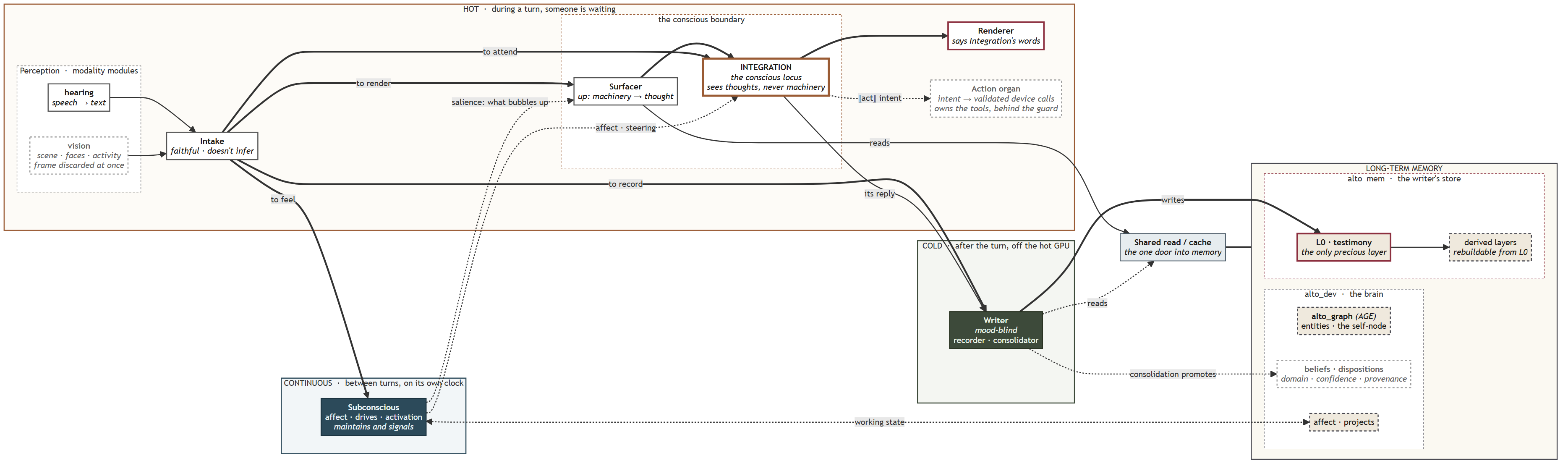
Source: alto-organs-overview.mmd — edit the .mmd and
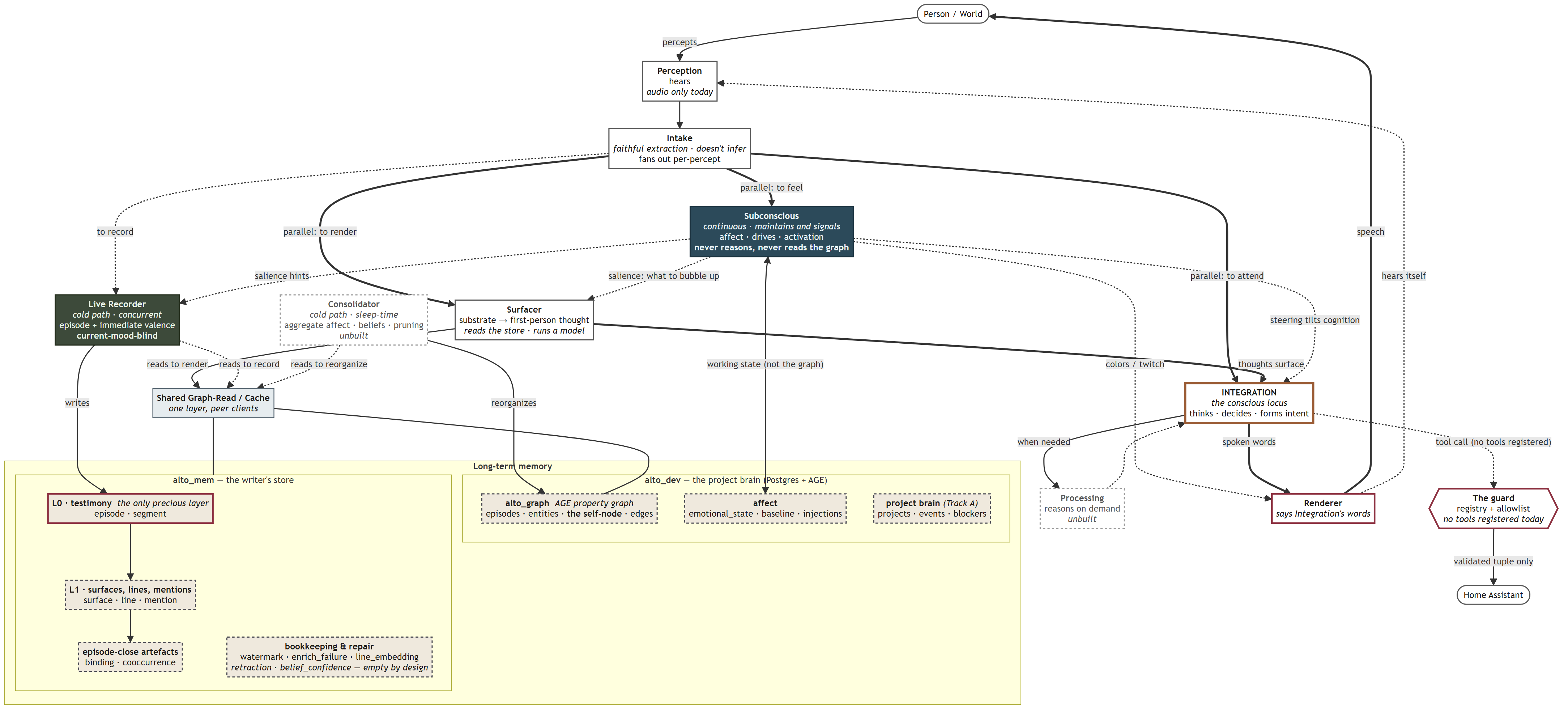
re-render, never the PNG alone. This is the orientation view. The full reference, with every
signal path and schema by name, is
alto-architecture-2026-09.png
(.mmd).
How to read it
The bands are the organizing idea. Every organ sits in exactly one, and which one tells you most of what you need before reading any of its code:
| Band | When | Budget | Failure mode |
|---|---|---|---|
| Hot | during a turn, someone is waiting | milliseconds — it is felt | never block; degrade, don't crash |
| Cold | after the turn | seconds | never corrupt; spool and retry |
| Continuous | always, between turns | its own clock | the largest unbuilt part of the system |
Dashed means designed but unbuilt. A dashed box is not a gap in the thinking — much of it is specified in depth. That is a different category from "not worked out yet", and the organ pages keep them apart.
Four things the picture is saying. Intake fans out in parallel to three peers, and
everything downstream consumes its percept rather than the raw words. (That is the design; in
code Intake was deleted on 2026-10-04 and every organ reads the raw words — see
Intake.) Integration is
sealed behind the Surfacer: it sees thoughts, never machinery, which is what makes honesty
structural rather than instructed. The Writer is a sibling, not a
subordinate, hanging off that fan-out on the cold path. And the design has one door into
memory: nothing reaches long-term storage around the shared read layer. (Built, that door is
mem — see Retrieval.) Integration is not a client of it: memory
reaches Integration only as thoughts the Surfacer renders.
The organs
| Organ | What it does | Today |
|---|---|---|
| Perception | a layer of modality modules; signal → raw symbols | hearing built; vision designed at the interface |
| Intake | raw symbols → a faithful grounded percept | removed 2026-10-04; perception's model-free hear stands in |
| Subconscious | continuous endogenous state; salience to the Surfacer, steering into Integration | not running — the earlier substrate is archived; to be rebuilt on mem |
| Integration | the one conscious locus: thinks, forms intentions | the organ runs; the layer around it does not, so it is exposed |
| Surfacer | machinery → first-person thought, up | rendering half only; reads alto_mem |
| Renderer | picks up Integration's spoken words and says them — a shell until there is a tone organ | built and on |
| Action organ | intent → validated device calls | sketched; the channel into it ships |
| Processing | reasons on demand, returns conclusions | only the web-search seam |
| Writer | persists experience to memory, mood-blind | mem's recorder runs every turn; enrichment is a batch job |
| Retrieval | the shared read layer, activation, and what memory holds | one store, mem, read by cue; no spreading activation yet |
| Identity | the cold-start self, accreted through testimony | working |
Two of these are not boxes in the overview, deliberately. Identity is not a component — it appears only as the self inside memory (the self-node of the design), which is the claim. Processing is below the altitude of an orientation map; it has a page. The guard on the device path has no page of its own: it is described in the Action organ.
The Articulator, which the design placed between Integration and the Renderer, is out of these pages until it is re-examined. It never had code: today Integration and the Renderer are one fine-tuned model, and the picture runs Integration straight into the Renderer.
Before you read the pages
"Built" here often means "built and switched off." Much of the system exists in code behind
a config flag that ships false. Each organ page names its own flags and their shipped values
— check there rather than inferring liveness from a module's existence.
Re-deriving an existing design is the most expensive mistake available here. Before concluding something is undesigned, read its page.
Where to go next
| Question | Read |
|---|---|
| Why is it built this way? | PILLARS.md |
| What does a word mean here? | GLOSSARY.md |
Pages cite code, specs, dated records and pull requests by path. Each citation that exists in
the private repository, at commit fcfdb827, links to it there. Those links open only if
you are signed in to GitHub with access to that repository; anyone else gets a 404.